
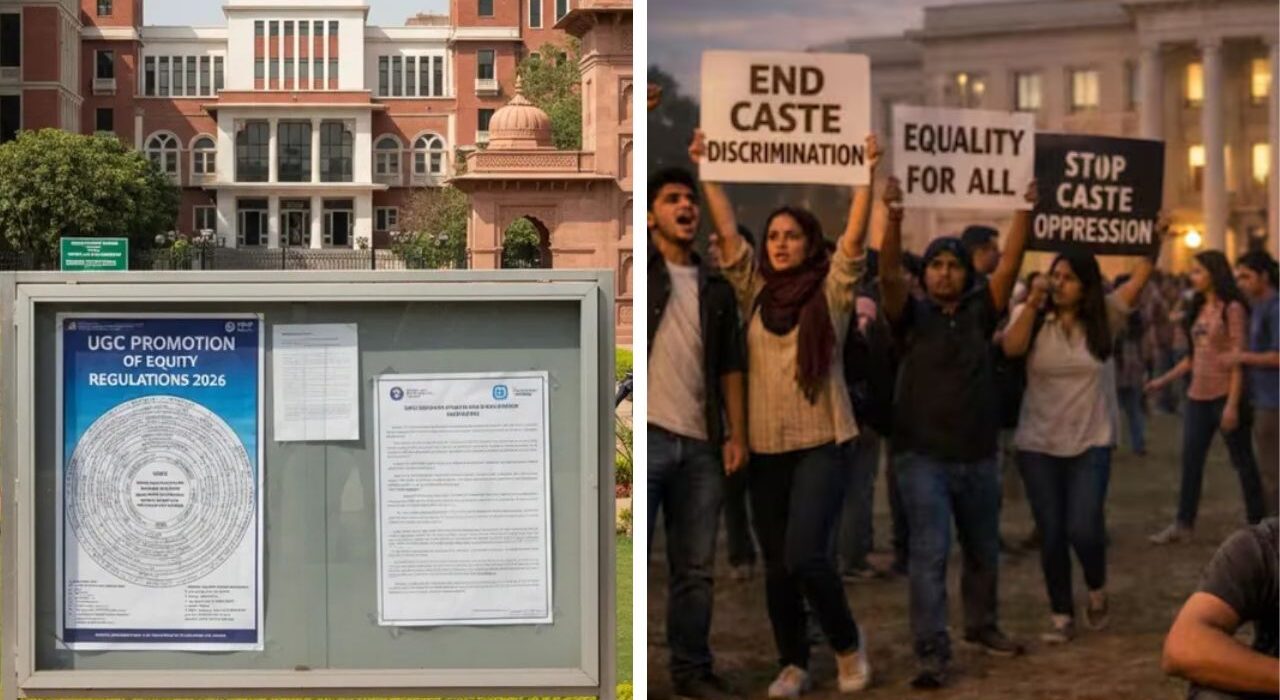
Recently, the government announced new UGC Equity Rules 2026 to handle caste-based discrimination faced by students from reserved categories in universities. According to the rules, all Higher Education Institutions (HEIs) must create a committee on campus to handle complaints about caste discrimination and ensure transparency and fairness across the institution.
However, this decision sparked protests from upper caste, or General category, students who claimed that no special provisions made for them. Protesters at the UGC headquarters also said that the regulations could lead to more complaints from reserved category students. Both the government and the protests have drawn responses, including a statement from the All India Student Association (AISA).
What Are UGC Equity Rules 2026?
Under the Equity Regulations, institutions must set up an Equal Opportunity Centre (EOC). This center will manage discrimination-related complaints and work toward including and supporting disadvantaged groups in colleges and universities.
Why Protests Against New Regulations?
The protests are led by the “Savarna Sena” outside the UGC headquarters. Shivam Singh, co-founder of the “Savarna Sena,” said that the group stop protesting if the government guarantees that general category students not negatively impacted. It occurs due to following reasons
- Protesters at the UGC headquarters claimed that General category students and others, not from reserved categories, cannot voice their complaints, as no clear provision exists for them in the new regulations.
- They also argued that the UGC Equity Rules 2026 may increase inequality rather than promoting fairness, believing that complaints from reserved categories could rise.
- Data shows that complaints related to caste discrimination in universities were around 173 during 2016-2017, but rose to over 350 in the 2023-2024 academic year, shows a increase in such cases.
Read also: Rape Case: Dhurandhar Actor Nadeem Khan Arrested Over False Marriage Promise Allegation